
Japan Karimen Written Test Practice: Mistake Review and Pre-Exam Checklist (2026)
Keep missing karimen questions after practising? Sort errors by rule knowledge, missed conditions, terminology and answering habits, then use delayed review and timed practice to check your progress.
Studying for the Japan provisional licence written test, or karimen, can become frustrating when familiar questions feel easy but a change of wording makes you hesitate. Before adding more practice questions, check what caused your mistakes.
This guide focuses on mistake review and pre-exam checks. For the overall process, read the karimen exam guide. To practise, open the karimen question bank on JapanDL.com, search WeChat for the mini program JP速通免许, or search the App Store for 日本免许速通.
01 | Choose the right test before you practise
The ordinary provisional licence written test uses 50 written true-or-false questions in 30 minutes. You need at least 45 correct answers, or 90%, to pass.
Karimen is a stage in obtaining a Japanese licence from the beginning. Foreign-licence conversion, known as gaimen kirikae, and the later full-licence test, honmen, are different routes or stages. A matching question count does not make the question banks interchangeable.
The study targets below are suggestions, not guarantees of a pass. Confirm your test language, registration arrangements and required documents with your driving school or test centre.
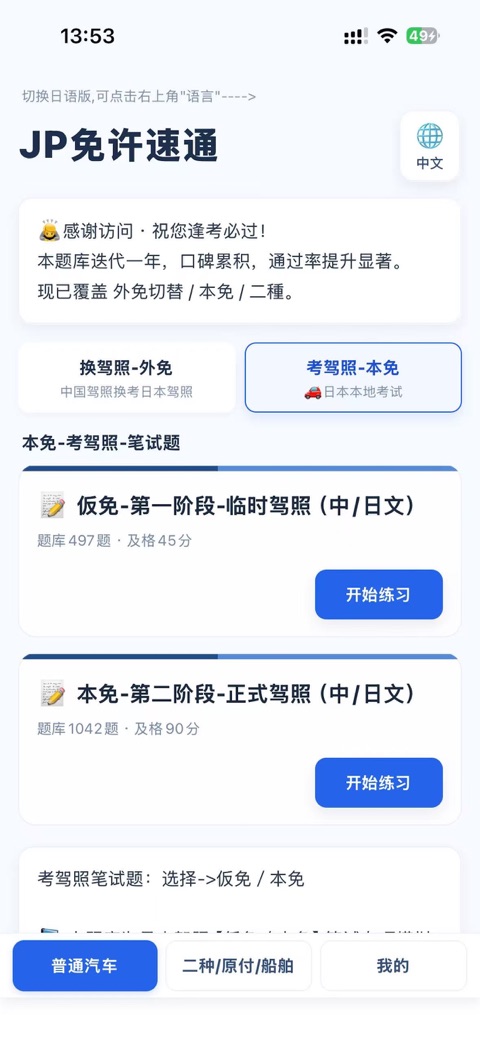
Published App Store screenshot, shown in Chinese: open “考驾照-本免” and choose “仮免-第一阶段-临时驾照” for karimen. Question totals and available content should be checked in the app's current display.
02 | Sort karimen mistakes into four groups
A rule you do not understand. If you still cannot explain the answer after reading the explanation, return to the learning material. Separate the vehicle involved, the situation and the required action.
A condition you missed. Check the time, location, vehicle type and words such as “may”, “must” and “must not”. Read the entire statement rather than predicting the answer from one word.
An unclear term or translation. Understand the concept in your stronger language, then connect it to terms such as ichiji teishi, jokō, chūsha and teisha. When switching languages, compare the same conditions; a wording difference is not automatically a rule difference.
A reading or input mistake. Record rushed reading, accidental taps, losing your place or changing an answer without a reason. These mistakes may require a better answering routine rather than more memorisation.
For each mistake, write one short note: “Which condition did I miss, and what will I check next time?” Copying an entire explanation is unnecessary.
03 | Review today, retry tomorrow, then mix the questions
Today: Finish the exercise before reviewing explanations. Prioritise the questions you understand least. Hide the answer and explain the reasoning in your own words.
Tomorrow: Retry the missed questions. A correct selection with no clear explanation can still mean you remember the option rather than the rule.
Later: Mix those questions with other material. Check whether you can still judge the statement when the order or wording changes.
JapanDL offers random practice, answer explanations, mistake review and full mock practice. Language switching can help you compare concepts. Select the karimen bank before a full practice session. Available content and access conditions are shown on each platform: JapanDL.com, WeChat JP速通免许 and the iOS app 日本免许速通.
Open the JapanDL.com karimen question bank
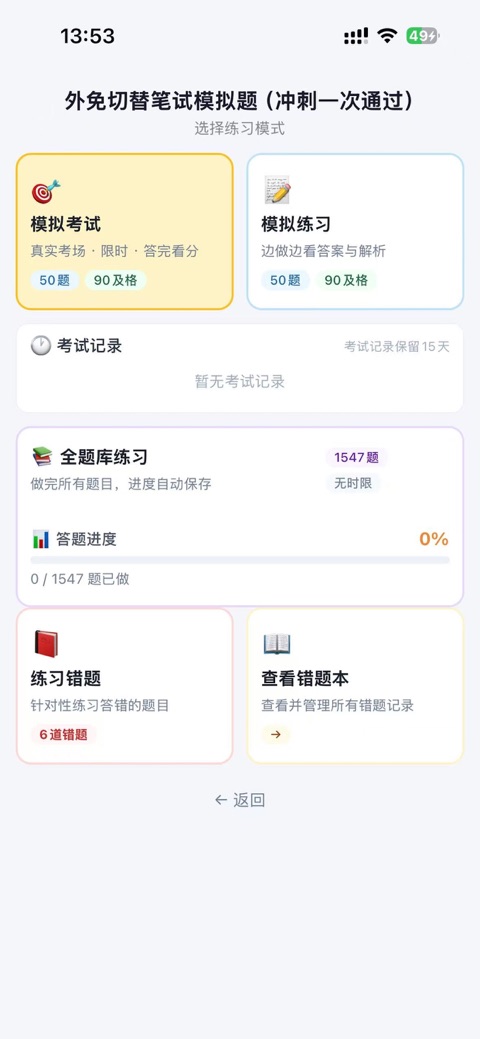
Example of the app's practice modes and mistake-review entries. This screenshot shows the foreign-licence conversion bank to illustrate the feature locations. For karimen, first select the karimen entry in the image above and follow the karimen test standard described in this guide.
04 | Make a mock test useful beyond its score
• Set aside 30 minutes for 50 questions, using a separate timer if needed. A learning mode's time setting may differ from the actual test.
• Keep reference material and explanations closed until you finish.
• Record recurring weak topics, questions you guessed and reading mistakes alongside the score.
• Use different question sets after a gap instead of repeatedly completing one familiar set.
45 correct answers is the pass threshold, not proof of complete understanding. Aim for a margin above the threshold in practice and the ability to explain your reasoning. Neither one high score nor a fixed number of completed questions guarantees the real result.
05 | Six checks for the day before the exam
• Have you chosen karimen rather than gaimen or honmen practice?
• Can you explain the causes of your recurring mistakes?
• Can you distinguish similar terms and their conditions?
• Have you completed an independent timed practice session?
• Have you checked your booking, arrival time, documents and test language?
• Have you planned travel and rest without leaving all new material to the final night?
06 | Common questions
Is memorising answers in my own language enough?
Your language helps you understand the material, but the underlying traffic rule determines the answer. Learn the conditions so a change of wording does not undo your preparation.
Can I stop reviewing a missed question after getting it right once?
Try it again the next day and within a mixed session. Explaining the reason is more useful than recognising a familiar option.
Can I use a conversion mock test because it also has 50 questions?
Shared rules can support your learning, but full mock practice should match the test you are taking. See the guide to choosing the right test bank if you are unsure.
What should I do after failing?
Review weak topics, language comprehension and answering pace. Ask your school or test centre about retaking the test. Focus practice on unresolved weaknesses instead of only repeating material you already understand.
Build your karimen study routine around understanding the error → retrying the next day → mixed practice → an independently timed mock test.
Start with the karimen question bank on JapanDL.com, WeChat mini program JP速通免许, or iOS app 日本免许速通, and turn rules you have read into decisions you can explain.