Japanese motorcycle license exam: Illustrations of 16 commonly used motorcycle hand gestures
Want to take the motorcycle driving test in Japan? It's very important to understand the commonly used hand signals! This article analyzes 16 core hand signals, covering signals for basic driving, formation management, safety warnings, etc. There are also tips for the road test to help you get your license smoothly and ride more safely!
I. Why is learning motorcycle hand signals crucial for motorcycle enthusiasts in Japan?
During the process of obtaining a motorcycle license (ordinary two - wheel/ large two - wheel) in Japan, although the skills test (road test) mainly examines the use of light signals and vehicle control, hand signals are the key to ensuring life safety in actual road riding and future group rides (ツーリング).
Due to the wind noise in helmets and possible connection problems with helmet Bluetooth headsets, hand signals have become the most intuitive and reliable "second language" among riders.
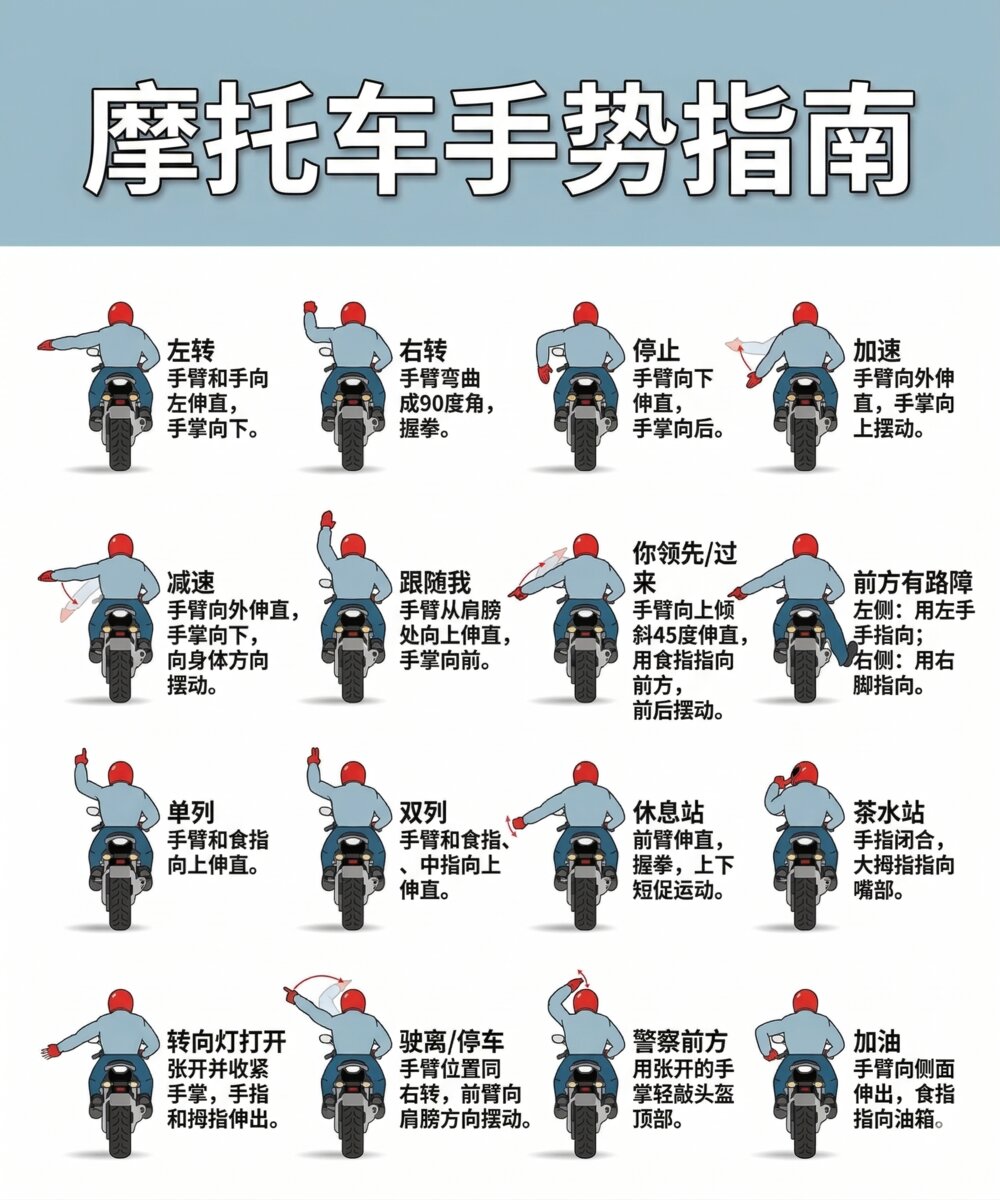
II. A full analysis of 16 core hand signals
Tip: In actual riding in Japan, most hand signals are made with the left hand because the right hand is needed to control the throttle and front brake.
1. Basic driving signals
- Left turn (左折): Extend the left arm horizontally to the left with the palm facing down. This is the most basic auxiliary signal.
- Right turn (右折): Bend the left arm at a 90 - degree angle and make a fist pointing upwards. This is very useful when the lights fail or additional reminders are needed.
- Stop (停止): Extend the left arm diagonally downwards with the palm facing backwards to remind the vehicle behind that you are about to come to a complete stop.
- Slow down (徐行): Extend the arm outwards with the palm facing down and swing it towards the body. This is a must - use signal when approaching an intersection or when there is congestion ahead.
2. Formation management and overtaking
- Follow me: Extend the arm upwards from the shoulder with the palm facing forward. Usually issued by the leader (Leader).
- You lead/Please overtake: Tilt the arm upwards at a 45 - degree angle and swing the index finger forward. This is used when giving way or changing the leader.
- Single - file/double - file formation: Extend the index finger or the index finger + middle finger respectively. Switch the formation when entering a narrow mountain road or driving on the highway.
3. Safety warnings
- Obstacle ahead: Point to the left obstacle with the left finger, and tap the ground with the right foot for a right - side obstacle. This is a very polite and professional habit among Japanese motorcycle enthusiasts.
- Police alert: Gently pat the top of the helmet with the palm. If you see a rider on the opposite lane making this gesture to you, immediately check your speed.
- Turn signal not turned off: Open and close the fingers after making a fist. This is a warm reminder among riders to avoid misleading the vehicles behind.
4. Daily supplies
- Refuel (給油): Point the index finger at the fuel tank.
- Tea stop/rest: Corresponding to the actions in the picture of pointing the thumb at the mouth or making a fist and moving it up and down, these are signals to maintain physical strength during long - distance rides.
III. Tips for the road test in Japan (Tips for Exam)
If you are preparing for the skills test (技能試験) of a Japanese driver's license:
- Visual confirmation (安全確認): Hand signals are only auxiliary. The most important thing in the road test is to "turn your head" to observe the rear and blind spots.
- Use lights first: You must give priority to using the mechanical turn signals during the exam.